

Kitchenware & Home Tools
Tumbler
Rolling Knife Sharpener
Tumbler's Rolling Knife Sharpener is one of the most advertised at-home knife sharpeners on Meta, and the only one in its category that shows a BESS sharpness test on camera (its longest-running ad to date).
And yet its winning creative stops at proving the sharpener works. It has yet to scale that proof to convert the buyer who has specific fears blocking purchase, or the one who's close to sold but highly skeptical.
- Product
- Tumbler Pro Stainless Steel
- Platform
- Meta Ads
- Deliverables
- Research, 3 briefs, landing page, AI statics
- Format
- UGC video, statics
Independent spec work, not affiliated with this brand. This is my own research, writing, and creative execution.
My process
From research-backed gaps to a structured test, and how I'd read the result.
Find the gaps
I ran my Ad Account Landscape Audit on Tumbler's 160 active Meta ads using Claude Cowork. Several are proven winners: two of the top 5 (by impressions) have run since October 11, 2025. A product demo appears in all five and in most of the creative library, making it the clearest proven format.
THE OPPORTUNITY
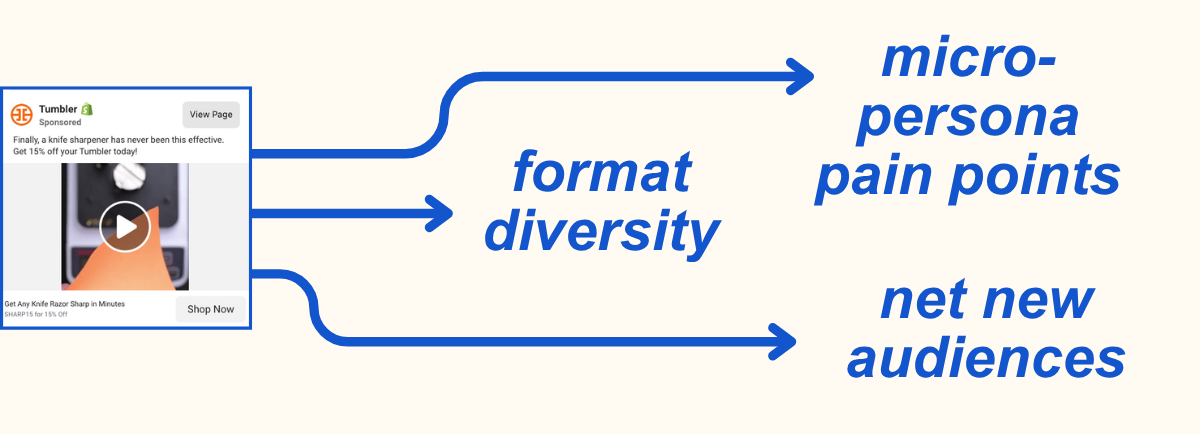
I also ranked every gap across Tumbler's creative, competitor creative, and customer research. Tumbler's ads target its highest-intent persona but lack the nuance to speak to the specific pain points and desires of the micro-personas within it. For example, the BESS sharpness test (the industry-standard blade sharpness scale, already in close to a third of Tumbler's live ads) has only ever been run by an anonymous demonstrator: no name, no credibility of their own, no personal stake in the result.
Its winning before-and-after format has also never been used as a static or with a lifestyle or narrative treatment. Scaling these winning mechanisms and widening format diversity would turn a handful of proven angles into more conversions across untapped micro-personas.
Briefs
📌 Briefs below are purely scripts + visual direction, written the way I'd pitch the creative vision to the client (you). That same direction gets a layer of technical depth added when it's handed off to creators and editors.
Brief 1: Loss-Aversion Before/After Demo (Risk-Averse Knife Owner, Most Aware)
The Risk-Averse Knife Owner is Most Aware, and stuck on one fear they haven't said out loud: "I don't trust myself to do this without messing up my knives." This ad names that fear, then resolves it with the magnetic angle holder.
HOOK VARIATIONS3 variants, same body
A $300 knife with a dull edge cuts worse than a sharp $20 one.
(VO)
Why does every 'premium' knife set come with a sharpening steel that barely does anything?
(VO)
The dirty secret of the knife industry? Dullness sells more knives.
(VO)
LEADthe story and the emotional tension
A knife that stays sharp is a knife you don't need to replace.
(VO, dry and knowing)
So before you go investing in any more knives, invest in the one thing that actually maintains the value of the knives that you already own.
(VO, confident/insider tone)
I cook with my knives every week and I've been putting off sharpening them because I'm worried I'll ruin them if I sharpen them wrong.
(VO, empathetic, matter-of-fact)
BASEthe product and the proof
That's why I invested in a rolling knife sharpener. Specifically the Tumbler Pro.
(VO)
It comes with a magnetic holder that locks your knife in at the perfect angle every time.
(VO)
Then all I have to do is roll the sharpener along my knife's edge.
(VO)
The diamond disc does the actual sharpening, and then you swap on the honing disc to smooth it out.
(VO)
And finish with the real leather strop for a clean polish.
(VO)
The whole thing takes a couple of minutes, and there's no real skill you have to learn.
(VO)
The best part is you only have to buy it once.
(VO)
These discs re-sharpen every knife you own, over and over.
(VO)
Get the Tumbler Pro so you can sharpen your knives, instead of struggling with them.
(VO, direct)
Customer language
The fear in this brief comes straight from a real Tumbler customer on Amazon: "I feared user error ruining our most valuable kitchen tools." The ad names that same worry out loud, in the customer's own terms.
Persona psychology
The Risk-Averse Knife Owner is Most Aware. They already know sharpeners exist and have done the research, so the ad never explains the category. They are stuck on one fear they haven't said out loud: "I don't trust myself to do this without messing up my knives."
Data-backed decision
A product demo shows up in all of Tumbler's top five ads and most of its creative library, so the demo is its proven format. This concept keeps the demo and changes one thing: it names the fear.
How I envision the final creative
Concept specs, not finished creator deliverables. Click media to view full-size.
Statics brief: No-Skill-Required angle (comparison, benefits, social proof)
MOF · ReframeThe Failed Whetstone Quitter is Product Aware. They already tried to sharpen their own knives and it didn't work, so they are now comparison shopping. These statics show the tool, not the person, as the problem.
Before/After Format Test
Testing whether a side-by-side before/after format (0% usage anywhere in the account currently) can carry the "no skill required" message that's already proven at ~33% usage in other formats, just never in this visual structure.
The account's existing statics stay product-forward (box shots, feature grids); this tests whether showing the person's experience instead of the product itself converts better for a buyer who's already stuck on "can I actually do this."
In-Use Callout Test
The account's reference ads already use annotated feature-grid statics (see the "Tumbler Pro Starter Set" and "Tumbler Starter Set" ads), but always on the packaged product. This tests the same annotated-callout format shot mid-use instead, so the claims ("perfect angle," "no skill required") have a real hand actually doing it as proof, not just label text next to a product shot.
Testing whether pairing the proven ease claim with an in-use demo (vs. a static object shot) moves it from an awareness-stage graphic to something that can also do decision-stage work.
Outcome-First Lifestyle Test
Every static currently in the account leads with the product in hero position and a hard "Shop Now" push; this tests leading with the outcome (a finished meal, Tumbler visibly used but not the focal point) to see if an outcome-first, lower-pressure read performs better with a buyer who's tired of being sold to directly.
Also testing the "nobody notices the process, they notice the result" reframe, an untested angle in the account that's distinct from the ease/no-skill claim Statics 1 and 2 are running.